

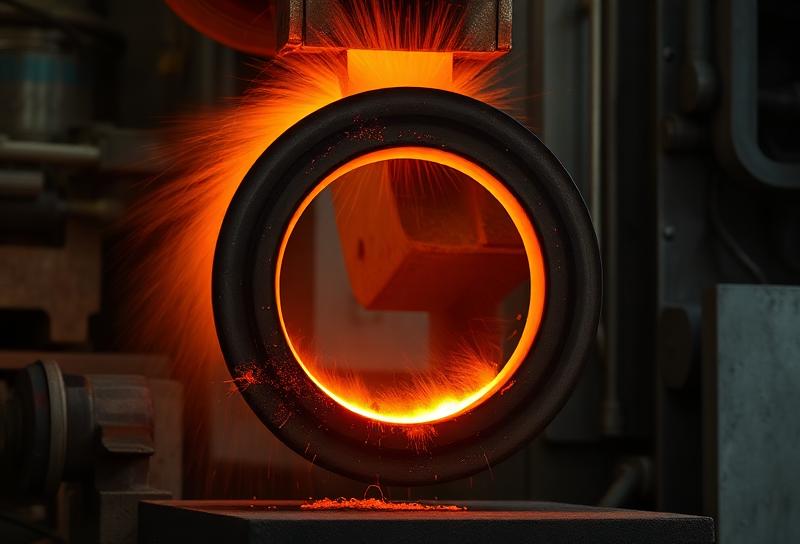
Manufacturers worldwide increasingly prioritize reducing 'cut weight' while keeping strength intact. Indian manufacturers—known for being leading bearing races manufacturer India companies—are adopting near-net-shape forging and advanced CNC machining to deliver precision bearing rings, forged bearing rings, and high-strength components for global buyers.
This article explores the science behind near-net-shape forging and how it benefits both manufacturers and end users.
What is Near-Net-Shape Forging?
Near-net-shape (NNS) forging is an advanced manufacturing process that produces parts very close to their final dimensions, minimizing the amount of material that must be removed during subsequent machining operations.
Key Characteristics:
1. Precision Dies: Custom-designed dies create parts within 1-2mm of final dimensions, compared to 5-10mm for conventional forging.
2. Controlled Material Flow: Advanced simulation and die design ensure uniform material distribution throughout the part.
3. Reduced Flash: Optimized blank design and forging parameters minimize flash (excess material) that must be trimmed.
4. Tighter Tolerances: NNS forging achieves tolerances of ±0.5mm on critical dimensions, compared to ±2mm for conventional processes.
Why Near-Net-Shape Forging Changes Everything
Modern forging systems in India provide several advantages that traditional forging cannot match:
1. Tighter, More Uniform Grain Flow: The controlled deformation in NNS forging creates optimal grain orientation that follows the part contour, maximizing strength in the load-bearing direction.
2. Minimal Machining Allowance: Less material to remove means faster machining, less tool wear, and lower overall manufacturing costs.
3. Improved Fatigue Life: The continuous grain flow pattern, combined with the work hardening from controlled deformation, significantly improves fatigue resistance.
4. Stronger Metallurgical Stability: Consistent deformation throughout the part ensures uniform mechanical properties, eliminating weak spots.
Applications in Bearing Manufacturing
NNS forging is particularly valuable for bearing components:
1. Ball Bearing Rings: Inner and outer rings for deep groove ball bearings benefit from the uniform grain structure that NNS provides.
2. Taper Roller Bearing Races: The complex geometry of taper bearing races is ideally suited to precision forging, reducing machining time significantly.
3. Spherical & Cylindrical Races: Large roller bearing components achieve better metallurgical properties through NNS forging.
4. German-Grade Kugellager Systems: Premium bearing applications require the superior quality that NNS forging delivers.
The Material Savings Advantage
One of the most compelling benefits of NNS forging is material savings:
Traditional Forging:
Near-Net-Shape Forging:
This 18% reduction in blank weight translates directly to material cost savings, reduced energy consumption in heating, and lower machining costs.
CNC Machining Enhances Final Accuracy
Many US and European buyers demand a combination of forging + CNC finishing. Indian exporters now supply CNC machined parts, precision machined components, and custom machined metal parts preferred by global buyers.
The NNS + CNC Combination Delivers:
1. Optimal Starting Point: The precision blank provides consistent stock for machining, reducing variation and improving quality.
2. Faster Cycle Times: Less material to remove means shorter machining cycles and higher productivity.
3. Better Surface Finish: Starting closer to final dimensions allows more finishing passes with light cuts, achieving superior surface quality.
4. Extended Tool Life: Consistent, moderate stock removal extends tool life compared to aggressive cuts on variable blanks.
Quality Control in NNS Forging
Achieving consistent NNS results requires rigorous quality control:
1. Die Monitoring: Regular die measurement and replacement before dimensional drift occurs.
2. Temperature Control: Precise heating ensures consistent material flow and grain structure.
3. Force Monitoring: Real-time press force monitoring detects variations before they cause quality issues.
4. Dimensional Inspection: 100% measurement of critical dimensions ensures every part meets specification.
5. Metallurgical Sampling: Regular destructive testing verifies grain flow and mechanical properties.
The Environmental Benefit
NNS forging contributes to sustainability:
1. Reduced Material Consumption: Less steel required means lower mining and processing impact.
2. Lower Energy Usage: Smaller blanks require less heating energy, and less machining means lower electricity consumption.
3. Decreased Waste: Less swarf (metal chips) to recycle reduces transportation and reprocessing energy.
4. Longer Product Life: Superior metallurgical properties mean bearings last longer, reducing replacement frequency.
Implementation Considerations
For manufacturers considering NNS forging, key factors include:
1. Volume Requirements: The tooling investment is justified for higher volumes (typically 10,000+ parts/year).
2. Part Complexity: Some geometries are better suited to NNS than others.
3. Material Selection: Not all bearing steels are equally forgeable. Material selection affects NNS feasibility.
4. Supplier Capability: NNS forging requires advanced equipment and skilled personnel. Supplier qualification is critical.
Final Takeaway
Near-net-shape forging represents the future of bearing ring manufacturing. By reducing cut weight while improving metallurgical properties, NNS forging delivers benefits to manufacturers (lower costs, faster production) and end users (better performance, longer life) alike.
For global buyers seeking precision bearing rings with optimized material usage, Indian manufacturers with NNS capability offer an unbeatable combination of quality, cost, and reliability.